







Kraken Sparks a New Cycle of Public Listings
Kraken’s confidential IPO filing on November 19, 2025, marks the most significant revival in the crypto initial public offering market since the peak of the 2021 cycle. This move comes not as speculative euphoria, but as a strategic signal that crypto firms are now striving to establish themselves as mature, credible financial infrastructure entities before global capital markets.
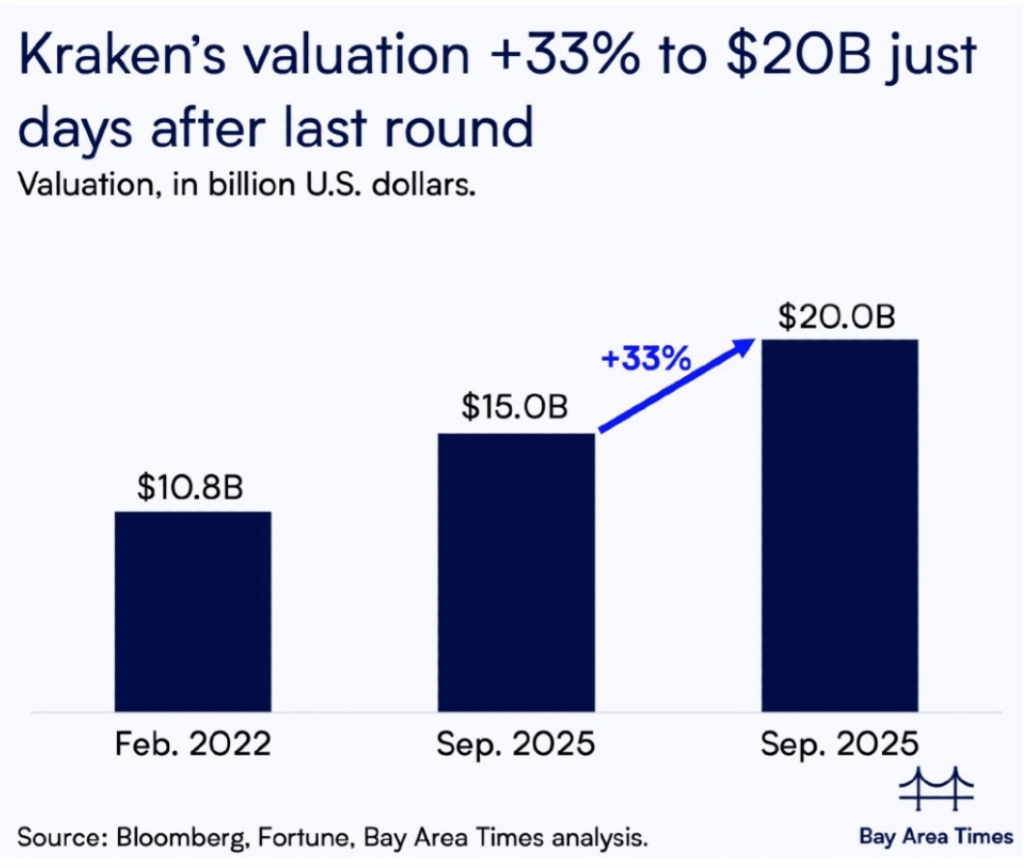
Just days before the filing, Kraken secured $800 million in funding across two tranches at a valuation of $20 billion, drawing backing from world-class institutions such as Jane Street, DRW Venture Capital, Oppenheimer, and Citadel Securities - names rarely seen leading traditional crypto rounds.
A New Industry Direction: From Speculative Startups to Public Financial Engines
Kraken’s move is not an isolated event. Following Circle’s earlier public listing, a lineup of players including BitGo, Gemini, Bullish, and Grayscale are also queuing up for public markets. This cycle is projected to form a collective market capitalization of nearly $100 billion, according to Bitwise CEO Hunter Horsley.
This trend reflects a paradigm shift. Crypto companies are no longer merely chasing hype-driven exponential growth, but are positioning themselves as sustainable businesses generating steady cash flow and operating under regulatory discipline on par with established financial institutions.
Market Window Reopens After the Crisis
After being battered by regulatory headwinds and major platform collapses throughout 2022-2023, the crypto IPO market had largely frozen. The resurgence began as Circle demonstrated strong reception from public investors, driven primarily by its standardized business model, audited financial statements, and institutional client base.
This momentum was followed by subsequent steps from BitGo, Gemini, Bullish, and Grayscale’s business restructuring toward public listings. What distinguishes this current wave is the character of market participants, who now resemble regulated financial institutions rather than high-risk speculative exchanges.
Kraken’s Financial Foundation: Profitability and Operational Discipline
Kraken posted $1.5 billion in revenue for 2024 and has already surpassed that milestone in just the first three quarters of 2025. What makes this achievement particularly notable is that the exchange had relied on just $27 million in external capital prior to its latest round, leveraging operational cash flow for global expansion and infrastructure development.
This strategy has produced a financial structure resembling traditional exchange holding companies: consistent profitability, controlled expenditure, and a balance between growth and cost stability.
Strategic Alliances and Multi-Asset Expansion
The entry of Citadel Securities with a $200 million investment commitment reinforces Kraken’s legitimacy among global capital market players. The market-making firm will also play a role in liquidity optimization and risk management, deepening the integration between crypto markets and modern trading architecture.
Meanwhile, Kraken has pursued aggressive expansion through key acquisitions:
- Small Exchange for $100 million to bolster its derivatives line
- NinjaTrader to expand multi-asset trading access
It also introduced xStocks as an equities trading platform. Its operational portfolio now spans derivatives, asset tokenization, equities, staking, regulated payments, and cross-jurisdictional clearing.
Evolution into a Global Multi-Product Exchange
No longer reliant solely on spot trading cycles, Kraken is configuring itself as an integrated multi-product and multi-country trading ecosystem. Regional expansion across Latin America, APAC, and EMEA is backed by a comprehensive licensing strategy, positioning it as a prime bridge between traditional markets and the on-chain ecosystem.
This model reflects a structural transformation: evolving from a conventional crypto exchange into a global trading hub equipped to handle future tokenized assets.
Implications for Governance and Industry Competition
The entry of crypto companies into public markets tightens transparency standards through mandatory quarterly reporting, regular audits, and regulatory oversight. This is expected to accelerate natural selection across the sector, favoring players that prioritize regulatory compliance and operational stability.
Scale of Opportunity: Massive Digital Financial Infrastructure
An estimated collective valuation approaching $100 billion underscores that the sector has transitioned from speculative assets toward a new class of financial infrastructure. Exchanges, custodians, tokenization platforms, and stablecoins now boast financial profiles comparable to mid-tier financial services firms.
Unlike the growth-projection-heavy cycle of 2021, the 2025 wave is anchored in audited revenues, institutional clients, licensed operations, and mature financial architecture.
A Signal of Crypto Industry Maturity
Kraken’s IPO is not just a corporate maneuver, but an indicator that the crypto sector is entering an institutional phase. Digital infrastructure is racing to become the backbone of tokenization, cross-border payments, institutional settlement, and global stablecoin issuance.
The involvement of players like Citadel Securities confirms that traditional markets are no longer passive observers, but are actively engaging in shaping blockchain-based financial structure.
This wave ultimately tests one key question: whether crypto firms can thrive under the rigors of public market governance and solidify their place as long-term pillars of a new global financial architecture - rather than a temporary anomaly of the digital era.
Disclaimer: This article is for informational and educational purposes only, not financial advice. Cryptocurrency assets are highly volatile and carry significant risk. Always do your own research (DYOR) and never invest more than you can afford to lose.